Canada’s 2026 federal budget, tabled on November 5, 2026, introduces a major structural tweak to how Canadians manage their retirement nest eggs: the creation of an "RRSP for life". Designed to cut red tape for hundreds of thousands of retirees every year, the proposal would eliminate the longstanding rule forcing savers to convert their Registered Retirement Savings Plans (RRSPs) into Registered Retirement Income Funds (RRIFs) at age 71.
While tax and estate specialists welcome the administrative relief, financial experts emphasize that the core tax rules—and the pressure of mandatory annual withdrawals—remain unchanged.
How the Current System Works
An RRSP is a tax-deferred investment account that allows Canadians to deduct contributions from their taxable income today while their investments, ranging from cash and GICs to stocks and ETFs—grow tax-free until withdrawal. For the 2026 tax year, Canadians can contribute up to 18% of their 2025 earned income, to a maximum limit of $33,810 (minus any pension adjustments).
Under existing Income Tax Act rules, an RRSP has a strict expiration date by December 31 of the year an account holder turns 71, they must either cash out the plan (triggering a massive lump-sum tax bill), buy an annuity, or convert the account into a RRIF.
What Budget 2026 Proposes
Rather than requiring retirees to open a brand-new account and transfer their assets at 71, Ottawa intends to merge the core features of the RRSP and RRIF into a single, lifelong plan. Key elements of the proposal include:
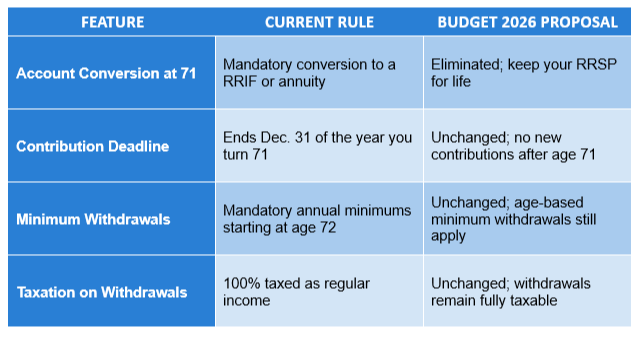
No mandatory conversion at 71: Canadians would be able to keep their existing RRSP open indefinitely, removing the administrative paperwork and potential account-transfer headaches at age 71.
Successor holder status for spouses: Currently, a surviving spouse can take over a RRIF seamlessly as a "successor holder" upon the owner's death, whereas an RRSP requires a more complex tax-deferred rollover process. Budget 2026 proposes extending successor holder status directly to RRSPs, allowing the plan to continue uninterrupted until the surviving spouse or common-law partner passes away.
Direct tax-free transfers on death: Ottawa is also exploring replacing the current indirect rollover rules, which require reporting the account's value as income on the deceased's final return alongside an offsetting deduction, with straightforward, direct tax-free transfers to qualified survivors' registered accounts.
What Stays the Same?
Despite the "RRSP for life" label, the government is not relaxing the tax rules governing when you must stop saving and start drawing down your funds:
Why Experts See Pros and Cons
Industry groups such as the Conference for Advanced Life Underwriting (CALU) and wealth advisors have praised the move as a practical modernization of Canada's retirement system. Eliminating the mandatory conversion prevents administrative errors, such as missed deadlines that could inadvertently deregister a senior's life savings and simplifies estate settlement for grieving spouses.
However, some financial professionals note that the change is largely administrative rather than financial. Because mandatory minimum withdrawals still kick in after age 71, seniors with substantial RRSP balances will continue to face forced taxable income each year, withdrawals that can push them into higher tax brackets or trigger Old Age Security (OAS) clawbacks.
Furthermore, social impact advocates point out that simplifying account mechanics offers little relief to the majority of Canadian seniors who lack workplace pensions and struggle with day-to-day affordability rather than asset management.
What Happens Next?
For anyone turning 71 this year, nothing changes immediately. Budget 2026 only outlines the government’s intention to introduce the measure. The Department of Finance has launched a public consultation open for written submissions from financial institutions, advisors, and Canadians until January 8, 2027 to iron out technical details. Formal legislation will need to pass through the House of Commons and the Senate before an official start date is set.
Sources:
Main Budget Plan (Masters of Our Destiny): In Chapter 6 ("A more efficient government")
Budget 2026 is proposing an ‘RRSP-for-life.’ Here’s what it means for you
DISCLAIMER: This article is for general information only and does not replace personalized financial advice. Please speak to a licensed financial advisor for guidance specific to your situation.